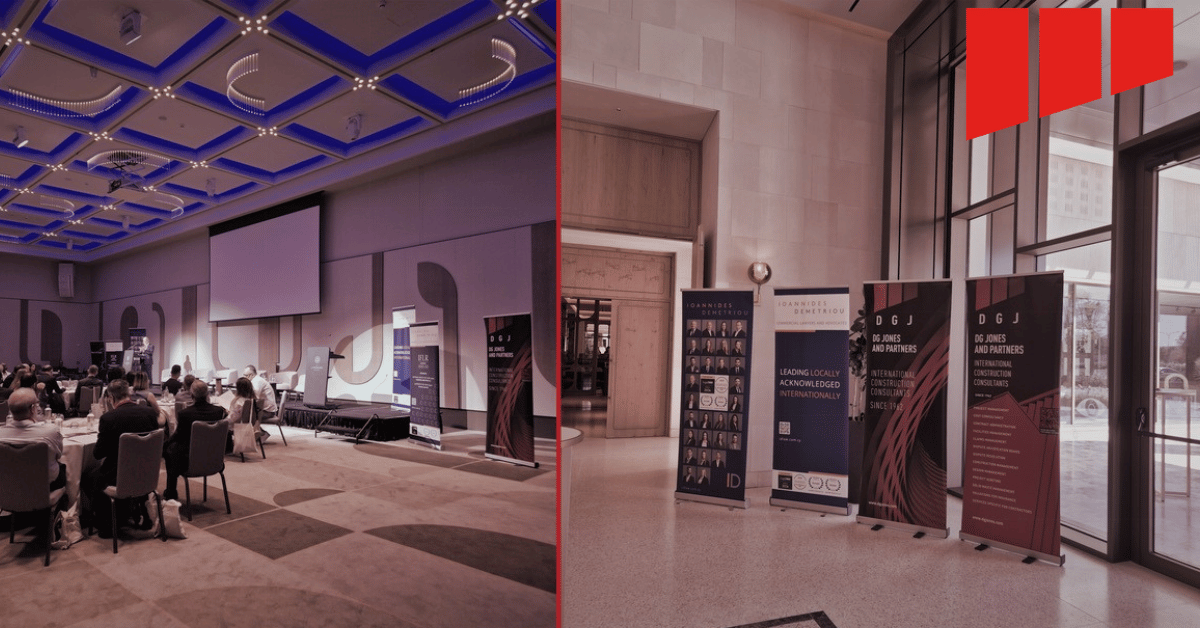
 DG Jones and Partners was proud to sponsor and participate in the CIArb Cyprus Branch Conference on specialisation as a trend in international commercial arbitration, held on 25 June 2026 at the Landmark Hotel in Nicosia.
Imagine a symphony in which every musician is accomplished, yet none has studied the score. The performance may proceed, but the nuance — the timing, the phrasing, the architecture of the piece — is lost. International commercial arbitration now confronts a similar question. In an era of increasingly intricate contracts, compressed programmes and multi-jurisdictional projects, is general competence still sufficient, or has specialisation become the cornerstone of credible construction dispute resolution?
That question framed the CIArb Cyprus Conference 2026, which brought together arbitrators, adjudicators, barristers, engineers, and quantum and delay experts from across Europe and the Middle East. DG Jones and Partners was honoured to support the event as a sponsor and to join a community of practitioners united by a shared conviction that the resolution of modern construction disputes demands not merely sound judgement, but deep technical fluency.
The conference opened with addresses from Mr Andrew Demetriou, Chairman of CIArb Cyprus, Mr Alexis Vafeadis, Minister of Transport, Communications and Works, and Mr Michael Vorkas, President of the Cyprus Bar Association — a testament to the standing of the event within both the legal and public spheres. The keynote address, delivered by Mr Cesar Pereira, President of CIArb, examined global trends in arbitration for construction and energy disputes and set the tone for a programme that was rigorous and forward-looking throughout. The conference also featured prominent international construction experts, including Mr Edward Corbett, author of FIDIC 4th – A Practical Legal Guide and a contributor to FIDIC 2017 – A Practical Legal Guide.
Structured across six sessions and five panels, the programme returned repeatedly to a single proposition: that the generalist tribunal may no longer be equal to the demands of the modern construction dispute. As contracts have grown more sophisticated, with bespoke amendments to standard forms drafted under FIDIC and other international contract standards, complex risk allocation and layered programmes, and increasingly complex factual backgrounds and technical requirements, the tribunal's ability to understand precisely what the parties agreed and how the events transpired becomes paramount. It was fitting, then, that the opening panel took as its subject whether a non-specialist tribunal can properly understand and apply modern specialised contracts.
The theme resonates with a principle we have long drawn on in our own practice: whatever the dispute resolution forum, the quality of the outcome rests upon the decision-maker's command of the subject matter.
The programme turned next to adjudication and Dispute Adjudication and Avoidance Boards. A panel was convened around a tension familiar to every practitioner: whether adjudication can remain fast while becoming more specialised. Speed is the discipline's founding virtue and depth its emerging obligation, and the balance between the two is a question the industry will continue to weigh.
The dispute board model reflects a broader principle the industry is steadily embracing, that the most economical dispute is the one that never crystallises. Well-drafted contracts, disciplined records, and proactive conflict avoidance strategies remain among the surest safeguards of project value.
Of particular resonance to our own practice was the session devoted to delay, disruption, and quantum, presented under a title that might serve as a maxim for the entire industry: that expertise is no longer optional. When substantial claimed value turns on the forensic reconstruction of a programme, or the correct measure of disrupted productivity, the analysis must be meticulous, methodologically robust, and defensible under cross-examination. Rigorous construction claims management, grounded in contemporaneous records, sound methodology and properly establishing causation, is where strong cases are built, long before a tribunal is ever convened.
A companion session considered the role of experts, evidence, and decision-making, posing the searching question of who really decides the case. It is a question that places a premium on the quality of expert witness evidence, and on experts whose independence and technical depth withstand scrutiny.
The closing panels looked ahead, to the composition of specialist tribunals, to the role of arbitral institutions in meeting new challenges, and, in a deliberately provocative final discussion, to whether the international construction industry might one day be better served by specialist AI arbitrators. It is a horizon worth contemplating. Technology will undoubtedly sharpen the tools of analysis, yet judgement, the weighing of evidence, credibility, and context, remains a profoundly human endeavour.
For a firm whose work spans both civil law and common law traditions, such questions carry particular weight. The differences in contracting and dispute resolution between Middle East and Western jurisdictions mean that specialisation is not merely technical but jurisdictional, a further argument for tribunals and advisers who understand the terrain.
For DG Jones and Partners, the themes explored at the Conference affirmed a principle upon which our practice has been built for decades, that credible outcomes rest upon genuine expertise. As international construction consultants established in 1962, regulated by the Royal Institution of Chartered Surveyors and active in more than 70 countries, we understand that resolving a construction dispute is not an abstract legal exercise but a matter of knowing how projects are priced, programmed, procured, and delivered, and where they depart from that course.
Our specialists provide impartial, independent advice to employers and contractors alike, from claims management and quantum analysis to expert witness services and support before adjudicators, dispute boards, and arbitral tribunals. Because we are wholly independent of the supply chain, our analysis is exactly what a tribunal requires — rigorous, evidence-led, and free of conflict. As arbitration grows more specialised, the symphony will increasingly be entrusted to those who know the score, and we intend to remain among them — a conviction we carry to the next generation through the DGJ Academy, where our practitioners teach arbitration and construction law.
If your organisation is facing a construction claim or dispute, or wishes to put in place the safeguards that prevent one, we invite you to speak with our Dispute Resolution team. Contact DG Jones and Partners to learn how our expertise can protect the value of your project.